Incoming Caller Name Announcer – Hear Caller Names Automatically on Your Phone
Receiving calls is a normal part of everyday life, but looking at your phone every time it rings can be inconvenient. You might be cooking, exercising, working, cleaning, or simply have your smartphone placed away from you. An Incoming Caller Name Announcer can make this easier by automatically speaking the caller’s name when a call arrives.
These apps generally use Text-to-Speech (TTS) technology to convert available caller information into spoken audio. If the incoming number matches a contact saved on your phone, a compatible app can announce that contact’s name. Depending on the application and device, it may also announce unknown numbers, SMS senders, battery information, or selected notifications.
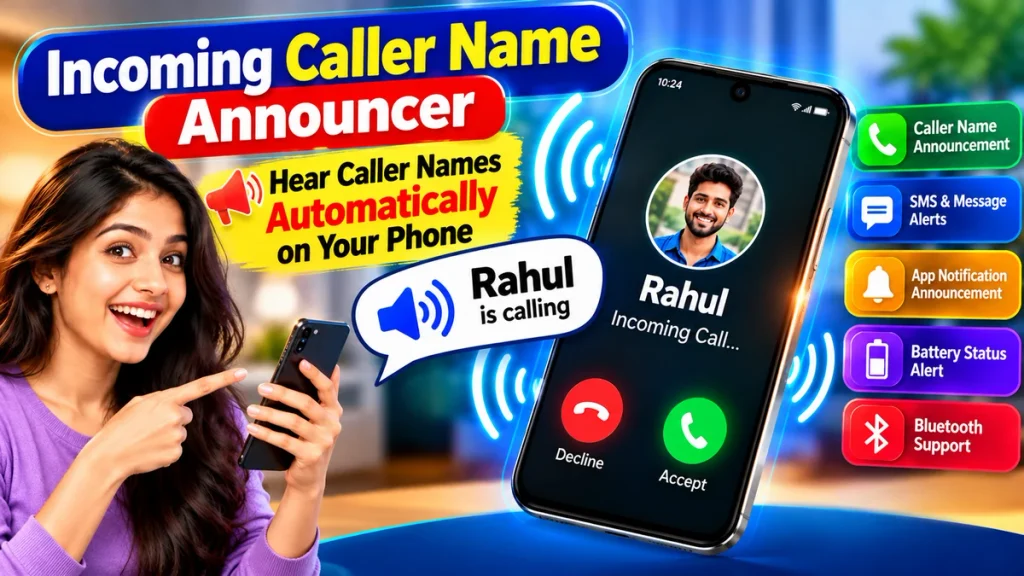
This guide explains how an Incoming Caller Name Announcer works, its main features, benefits, setup process, privacy considerations, and how to use caller announcements effectively.
Incoming Caller Name Announcer – Quick Overview
| Feature | Details |
|---|---|
| App Type | Caller Name Announcer |
| Main Function | Automatically announces caller names |
| Technology | Text-to-Speech (TTS) |
| Saved Contacts | Can speak saved contact names |
| Unknown Numbers | May announce the phone number |
| SMS Announcements | Available in some apps |
| Voice Settings | Language, speed and pitch may vary |
| Repeat Option | Available in selected apps |
| Bluetooth Support | Depends on app and device |
| Offline Use | Some basic features may work offline |
| Best For | Hands-free caller identification |
What Is an Incoming Caller Name Announcer?
An Incoming Caller Name Announcer is a smartphone utility that provides spoken information when someone calls you.
Normally, your phone shows the caller’s name or number on its display. With caller-name announcement enabled, compatible software can speak that information aloud.
For example, if you have a contact saved as Rahul, your phone could announce:
“Incoming call from Rahul.”
You can then identify the caller without immediately checking your screen.
The exact announcement depends on the application, phone model, operating system, permissions, and Text-to-Speech settings.
How Does Automatic Caller Name Announcement Work?
Most caller-announcement applications rely on your smartphone’s Text-to-Speech engine.
When an incoming call is received, the application uses caller information made available by the operating system. If the phone number corresponds with a saved contact, the contact name can be passed to the TTS engine.
The Text-to-Speech engine then converts that name into spoken audio.
In simple terms, the process works like this:
Incoming Call → Caller Information → Saved Contact Match → Text-to-Speech → Voice Announcement
Because smartphones handle calls, permissions, background processes, and audio differently, the exact performance can vary between devices.
Why Use an Incoming Caller Name Announcer?
The biggest advantage is convenience. You can hear who is calling without having to pick up your smartphone every time it rings.
Useful When Your Hands Are Busy
Imagine that you’re preparing food and your hands are wet. Your smartphone starts ringing on a nearby table.
Instead of touching the phone just to identify the caller, the announcement can tell you who is calling.
This can also be useful while cleaning, gardening, doing household work, or completing other hands-on tasks.
Convenient During Exercise
Checking your smartphone repeatedly during exercise can interrupt your routine.
If your phone announces incoming caller names, you can know who is calling while walking, exercising, or doing a workout.
You can then decide whether the call needs your attention.
Helpful While Working
Incoming calls can interrupt concentration.
Automatic caller announcements provide basic information without requiring you to immediately look away from your work and check the display.
Audio-Based Accessibility
Spoken caller information may also complement accessibility tools for users who prefer audio feedback or find visual caller information difficult to read.
Important Features of Incoming Caller Name Announcer Apps
Different apps offer different features. However, several functions are commonly associated with caller-name announcers.
1. Automatic Caller Name Announcement
This is the primary feature.
When a saved contact calls, the app can automatically announce the contact name without requiring you to open the application.
For example:
“Rahul is calling.”
2. Unknown Number Announcement
What happens when someone who isn’t saved in your contacts calls?
Some applications can read the incoming phone number aloud. Others may provide a generic notification such as “Unknown caller.”
The feature depends on the information available to the application.
3. SMS Sender Announcement
Some caller-announcement apps also support SMS alerts.
When a text message arrives, the app may announce the sender’s name.
Some applications may additionally offer message-content reading, subject to device permissions and operating-system restrictions.
4. Custom Announcement Text
Some applications allow you to customize what the phone says.
Instead of simply announcing “Rahul,” you could configure a phrase such as:
“You have an incoming call from Rahul.”
Custom phrases can make announcements easier to understand.
5. Repeat Caller Name
Depending on the application, the caller’s name may be repeated while the phone rings.
Users may be able to select whether the name is announced once, twice, or more often.
Avoid excessive repetition because it can quickly become distracting.
6. Voice Speed and Pitch
Text-to-Speech engines often provide options for adjusting voice speed and pitch.
A slower speech rate can help make unfamiliar names easier to understand.
7. Multiple Language Support
TTS engines may offer multiple languages and voices.
If your contact list contains names written in a regional language, selecting a suitable TTS voice may improve pronunciation.
However, language availability depends on your smartphone and installed voice data.
8. Bluetooth and Headphone Support
Some users may prefer caller announcements through headphones or Bluetooth accessories rather than the phone’s loudspeaker.
Compatibility varies depending on the phone, operating system, app, and connected audio device.
Features Comparison
| Function | Purpose |
|---|---|
| Caller Name Announcement | Speaks saved contact names |
| Unknown Number Alert | May read an unsaved phone number |
| SMS Sender Alert | Announces the message sender |
| Message Reading | Reads SMS content where supported |
| Custom Announcement | Personalizes spoken caller alerts |
| Repeat Control | Sets announcement frequency |
| Voice Speed | Changes speech rate |
| Voice Pitch | Adjusts voice characteristics |
| Language Selection | Selects supported TTS language |
| Bluetooth Support | May route announcements to connected devices |
How to Set Up an Incoming Caller Name Announcer
The exact steps depend on the app, but the general process is relatively simple.
First, search for a suitable caller-name announcement application in your phone’s official app store. Review the app’s developer information, description, recent updates, ratings, privacy information, and permissions before installing it.
Once installed, open the application and locate the Incoming Caller Name Announcement option.
Enable the feature and grant only the permissions needed for the functions you plan to use.
Next, open your phone’s Text-to-Speech settings if necessary. Select an appropriate language and voice.
Adjust the speech speed so that names sound clear and natural.
If the application provides repeat controls, silent-mode settings, or Bluetooth options, configure them according to your preferences.
Finally, safely test the feature by receiving a call from another phone.
Can Caller Name Announcer Work Without Internet?
Some basic caller-name announcements may work without an active internet connection.
If your contact information is stored locally and the required Text-to-Speech voice has already been downloaded to your smartphone, the phone may be able to generate the announcement offline.
However, not every function is guaranteed to work offline.
Cloud-based voices, online services, advertisements, updates, and certain additional app features may require internet access.
Therefore, users who specifically need offline caller announcements should check the individual application’s functionality.
Using Caller Name Announcer with Bluetooth
Bluetooth can make spoken caller alerts more convenient and private.
For example, if you’re wearing Bluetooth headphones, you may want the caller’s name to play through your headphones rather than through the phone’s speaker.
Whether this works depends on several factors, including the app, smartphone, operating-system version, Bluetooth device, and audio settings.
Because Bluetooth behavior varies, testing the app with your particular device is the best way to confirm compatibility.
Caller Name Announcement While Driving
Voice caller announcements can reduce the need to look at your phone solely to identify an incoming caller.
However, this feature should never be considered permission to use a phone unsafely while driving.
Avoid manually interacting with your smartphone while driving where doing so is unsafe or prohibited. Follow local traffic regulations and use appropriate hands-free systems where permitted.
A caller-name announcement should provide information without creating additional distraction.
Privacy and Permission Considerations
Privacy is one of the most important factors to consider before installing a caller-announcement app.
Depending on its functions, an application may request access to contacts, phone-related information, notifications, SMS, or other data.
Some access may be required for a particular feature. For example, contact information may be needed to determine the saved name associated with an incoming number.
However, you should still review every requested permission and avoid granting access that doesn’t appear relevant to the application’s functions.
There is also the issue of audio privacy.
If your phone announces a contact’s name aloud, people nearby may hear who is calling.
This is even more important with SMS content. If message-reading is enabled, potentially private information could be spoken aloud.
For greater privacy, consider limiting announcements to caller names or SMS sender names.
Advantages and Limitations
| Advantages | Limitations |
|---|---|
| Automatic caller identification | Compatibility varies by device |
| Reduces need to check the screen | Announcements can disturb others |
| Useful when hands are busy | Requires relevant permissions |
| Helpful during exercise or work | Some names may be mispronounced |
| Multiple languages may be supported | Language support varies |
| SMS sender alerts may be available | Full message reading can affect privacy |
| Bluetooth may be supported | Audio routing differs by phone |
| Basic features may work offline | Some functions require internet |
Tips for Better Caller Name Announcements
Keep contact names simple and clearly written. Symbols, unusual abbreviations, and mixed-language names can sometimes make pronunciation more difficult.
Select a TTS language that matches the language of most of your contacts.
If announcements sound too fast, reduce the speech speed slightly.
You should also control the number of repetitions. One or two announcements may be enough for most users.
Use silent or Do Not Disturb settings when you’re in meetings, classrooms, libraries, hospitals, or other places where spoken announcements could disturb people.
Finally, disable any features you don’t need. If you only want incoming caller names, you don’t necessarily need SMS content or other notification-reading features.
Frequently Asked Questions (FAQ)
1. What is an Incoming Caller Name Announcer?
It is a smartphone feature or application that uses spoken audio to announce available information about an incoming caller.
2. Does it automatically announce saved contact names?
When properly configured and supported by the device, it can automatically announce the names of saved contacts during incoming calls.
3. What happens if the caller isn’t saved?
Some apps can announce the incoming phone number, while others may provide a generic unknown-caller alert.
4. Does Caller Name Announcer need internet?
Some basic functions may work offline when the required contact data and TTS voice are stored locally. Other features may need internet access.
5. Can I change the voice?
Available voice options depend on your smartphone’s Text-to-Speech engine and installed voice packages.
6. Can it announce SMS senders?
Some applications support SMS sender announcements when the necessary permissions and system support are available.
7. Can it read my SMS messages aloud?
Some apps may provide this feature. Consider privacy carefully before enabling complete message reading.
8. Does it work with Bluetooth headphones?
It may, but compatibility depends on the smartphone, app, operating system, and Bluetooth device.
9. Can I stop announcements in silent mode?
Some apps provide silent-mode controls. Device sound and Do Not Disturb settings may also affect announcements.
10. Why are some names pronounced incorrectly?
TTS engines can have difficulty with unusual names, abbreviations, regional spellings, or mixed-language contact entries.
Conclusion
An Incoming Caller Name Announcer offers a convenient way to hear caller names automatically on your phone without repeatedly looking at the screen.
By using Text-to-Speech technology, compatible applications can announce saved contact names and may provide additional functions such as unknown-number alerts, SMS sender announcements, custom phrases, language selection, repeat controls, and Bluetooth support.
The feature can be especially useful when you’re cooking, exercising, working, or handling other activities where checking your smartphone isn’t convenient.
For a better experience, choose a trusted app, review its permissions, configure an appropriate TTS voice, and enable only the features you actually need. Privacy should also remain a priority, especially when caller names or message content could be heard by other people nearby.
With the right configuration, an Incoming Caller Name Announcer can provide a simple and practical hands-free way to stay informed about incoming calls.